Most Australian small businesses unfortunately are spending money on ads that don't convert, posting on social media that nobody sees, and cutting their prices just to stay competitive. The result? Wasted budget, frustrated owners, and a business that's working harder than it needs to.
The fix isn't a new app, a trending platform, or another "growth hack." It's something far more basic and most business owners have never been properly taught it.
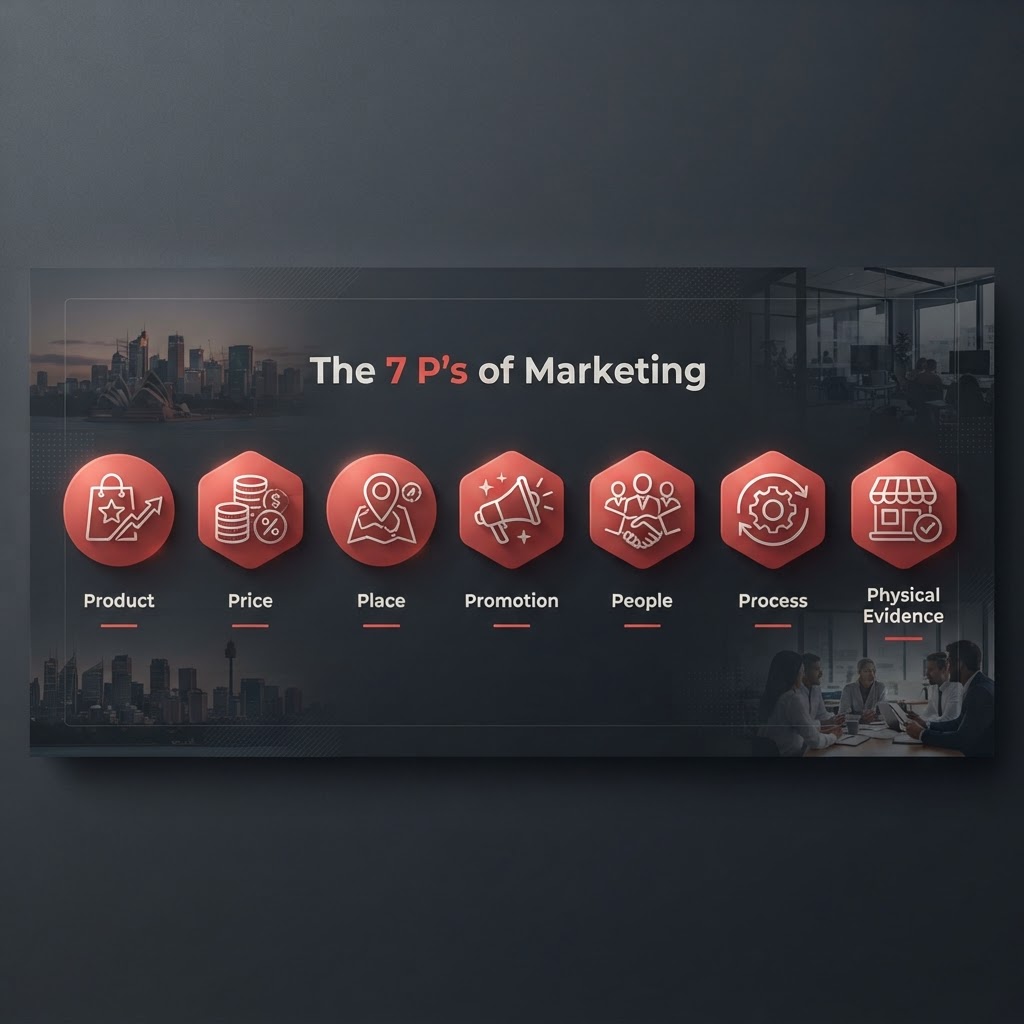
The 7 P's of marketing is the framework that underpins every successful business strategy on the planet. When focused to the Australian market, it becomes one of the most powerful tools a small business owner can have. No theory. No garble. Just a realistic look at what actually works and more importantly, how to make it work for you.
What Are the 7 P's of Marketing?
The Marketing Mix: A Framework Built for the Real World
The original marketing mix began with just four elements Product, Price, Place, and Promotion it was developed by an economist Neil Borden in the 1950s and then refined by E. Jerome McCarthy.
By the 1980s, it was clear that the service economy and how we conducted business was changing with the introduction of computers and later the internet. A couple of academics "Booms and Bitner" added People, Process, and Physical Evidence, and the 7 P's framework was born.
Here's what most textbooks won't tell you: this framework only delivers results when you stop treating it like an academic exercise and start using it as a diagnostic tool for your actual business.
Think of the 7 P's as seven levers. Pull the wrong ones in isolation and nothing moves. Understand how they work together and you've got a business that runs like a tuned engine.
Why Do the 7 P's Matter Right Now?
According to a 2023 report by the Australian Small Business and Family Enterprise Ombudsman, there are approximately 2.5 million small businesses in Australia. Amazingly, these account for 97% of all businesses in the country. Yet research consistently shows the majority of those businesses operate without a documented marketing strategy.
That's the gap the 7 P's can close.
The 7 P's at a Glance
| P | Focus Area | Why It Matters |
|---|---|---|
| Product | The offer and experience | Must solve a real problem customers actively feel |
| Price | Value, not just cost | Competing on price alone erodes margins |
| Place | Access and distribution | Customers must be able to find and buy easily |
| Promotion | Visibility to the right audience | Depth beats breadth across channels |
| People | Your team and service delivery | Your team is your brand |
| Process | Systems and workflows | A smooth experience sells itself |
| Physical Evidence | Trust signals | Proof of credibility before purchase |
Why Each P Matters for Australian Small Businesses
Product: Your Offer Needs to Solve a Real Problem
Your product or service is the most important part. And "product" doesn't just mean what you sell it also means the full experience of what the customer receives, including quality, features, packaging, support, and service.
A large number of Australian small businesses are selling what they want to sell, not what the market actually wants to buy.
As an example, a Melbourne based landscaping company was pushing premium garden design packages, they did good work and had high margins. But their local market was dominated by rental properties and their target market just wanted reliable maintenance at a fair price. After putting together a recurring maintenance package their sales increased consistently over the next 6 months.
Ask yourself: Does your product solve a problem your customers are actively feeling right now?
Price: Competing on Price Alone Is a Race to the Bottom
Pricing is often one of the hardest and most emotionally charged of the 7 P's. However it is often handled with gut instinct rather than strategy.
Australian consumers are becoming increasingly more price sensitive, especially with this high interest rates and inflationary environment. But the answer is not to automatically cut your prices.
Research from Deloitte Access Economics found that small businesses competing primarily on price have, on average, 20% lower profit margins than those competing on value.
Smart pricing is about perceived value, not just cost. How do you achieve value?
We researched a Cairns electrician who introduced a three tier service package consisting of standard, priority, and emergency. This alone saw his average job value increase by $180 almost immediately.
Place: Your Distribution Strategy Is Your Competitive Advantage
"Place" is where and how your customers access your product or service. In 2026, this obviously isn't just about your physical location, it's about meeting your customer wherever they are in their buying journey.
Keep in mind, Australian ecommerce now accounts for more than 16% of total retail sales, according to Australia Post's Inside Australian Online Shopping report. If your business doesn't have a clear digital sales pathway, you're definitely leaving money on the table.
To explain further, as an example, for tradies and service businesses, "place" means:
For retailers, it might mean:
Promotion: Getting Seen by the Right People & Not Just More People
Promotion covers every way you communicate your offer to the market. It includes advertising, content marketing, social media, SEO, email, PR, referrals, and more.
A mistake some Australian small businesses make with promotion is spreading themselves too thin. They're on Facebook, Instagram, TikTok, LinkedIn, running Google Ads, sending newsletters, and doing letterbox drops. They end up doing none of it really well.
According to the Australian Marketing Institute, businesses that focus on two to three core promotional channels and perform them consistently outperform those using five or more channels poorly. Depth beats breadth.
For most local service businesses and retailers, a high-performing promotional foundation looks like:
Build that engine first. Then expand.
People: Your Team IS Your Brand
In service businesses especially, the people delivering your service are the product. Every interaction from the first phone call to the final invoice shapes the customer's perception of your brand.
This P is regularly overlooked or skimmed over. Business owners spend hours designing a logo and minutes training their reception staff on how to handle enquiries.
A Sydney property management firm was losing clients not because of poor service quality, but because their communications were slow and were perceived as impersonal. After implementing a more client focused communication policy and training their team on tone and response times, they reported more happy tenants and less headaches.
Your people are your most powerful marketing asset but they can also be your most costly liability. Train, coach, and monitor them accordingly.
Process: A Smooth Experience Sells Itself
Process refers to the systems and workflows that deliver your product or service.
A chaotic customer experience even with a great product can destroy word of mouth and repeat business.
Walk through every touchpoint in your customer journey:
The businesses growing fastest in Australia right now aren't necessarily the ones with the best product. They're the ones with the smoothest, most frictionless customer experience.
Automate what can be automated. Document what needs to be consistent.
Physical Evidence: Make the Invisible Visible
For service businesses, physical evidence answers the customer's first question: "How do I know I can trust you?"
Physical evidence includes:
According to BrightLocal's Local Consumer Review Survey, 87% of consumers read online reviews before choosing a local business.
Your reviews, your portfolio, your social proof. They're not nice-to-haves. They should be the core to your marketing strategy.
If a potential customer lands on your website and can't quickly find evidence that you're credible, experienced, and trustworthy chances are they're gone. Build the evidence. Put it front and centre.
Practical Steps to Implement the 7 P's in Your Business
Step 1: Audit First & Then Act
Before you change anything, conduct an honest assessment of where you currently stand across all seven areas.
Score yourself out of 10 on each P:
| P | Score (out of 10) |
|---|---|
| Product | |
| Price | |
| Place | |
| Promotion | |
| People | |
| Process | |
| Physical Evidence |
Most businesses find one or two P's that are genuinely strong and four or five that are not where they want them to be. That's normal and this key point is exactly where the growth is hiding. Start with your lowest scores. Those are your BIG opportunities.
Step 2: Build the Foundation Before Scaling
One of the most common and often the most expensive mistakes we see is businesses trying to scale and promote themselves before the other six P's are solid.
You can drive all the traffic in the world to a broken process, a poor service experience all you'll achieve is burning through your marketing budget faster.
Fix the foundation first:
Then pour fuel on it with promotion.
Step 3: Review the 7 P's Every Quarter
Markets change. Consumer expectations shift. Competition evolves. The 7 P's isn't a set-and-forget process, you should review your business regularly to identify what should change and where the opportunities are.
Schedule a quarterly marketing review. Work through each P. and ask:
Businesses that do this make faster, smarter decisions than those reacting to problems after they've already cost them customers and revenue.
Ready to Stop Guessing and Start Growing?
The 7 P's of marketing is not complicated but applying it effectively to your specific business, in your specific market, with your specific circumstances, takes expertise and good analysis.
At Red Dog Advisory, we work with Australian small businesses to build marketing strategies that are tailored to the local market, and designed for growth. We don't sell tactics before the strategy is clear. We start with the foundation and build from there.
Whether you're a tradie trying to build a more systemised business, a local retailer going up against the big chains, or a service business tired of inconsistent enquiries the 7 P's framework is where every engagement we run begins.
🔍 Explore Our Services See how Red Dog Advisory helps Australian small businesses build marketing strategies that actually work. Real results. Real businesses. No Garbage
Explore More Marketing Tips Here
Red Dog Advisory helps Australian small businesses cut through the noise and build marketing strategies that deliver real results. Based in Australia. Built for Australian businesses.
Frequently Asked Questions: The 7 P's of Marketing for Australian Small Businesses
Q: What are the 7 P's of marketing?
The 7 P's of marketing are Product, Price, Place, Promotion, People, Process, and Physical Evidence. Together they form the extended marketing mix which is a framework used by businesses to develop strategies that meet customer needs, compete effectively, and drive growth.
Q: How can Australian small businesses implement the 7 P's of marketing?
Start with an audit. Score your business from 1–10 across each of the 7 P's to identify where the gaps are. Then prioritise improvements in your weakest areas. Reviewing the framework quarterly ensures your strategy stays aligned with market changes.
Q: Why is pricing strategy important for small businesses in Australia?
Pricing directly affects both revenue and how customers perceive your value. Australian small businesses that compete solely on price tend to operate with margins 20% lower than competitors who compete on value. Strategies like tiered pricing, bundling, and price anchoring can increase average transaction prices without adding extra work.
Q: What does "Place" mean in the 7 P's of marketing for a service business?
For a service business, "Place" refers to every channel through which a customer can find, access, and engage with you, this includes your Google Business Profile, website, suburb specific landing pages, and booking systems. It's about ensuring your business is easy to find and easy to buy from, both online and offline.
Q: How does "People" affect marketing for small businesses?
In service-based businesses, the people who deliver your service are effectively your product. The way your team communicates, responds, and presents themselves shapes customer perception at every touchpoint. Well-trained staff who reflect your brand values improve retention, referrals, and reputation.
Q: What is physical evidence in marketing, and why does it matter?
Physical evidence is every element that communicates trust and credibility before a purchase is made. These include your website design, Google reviews, testimonials, uniforms, certifications, and portfolio.
Since 87% of Australian consumers read online reviews before choosing a local business (BrightLocal), your physical evidence directly influences whether prospects convert.
Q: How often should small businesses review their marketing strategy?
At least quarterly. Markets shift, consumer expectations evolve, and what worked six months ago may need adjustment. A quarterly review of the 7 P's helps business owners identify market shifts early, and shows new opportunities. It also forces you to make proactive decisions rather than reactive ones.
Q: How can the 7 P's of marketing help tradies and local service businesses in Australia?
The 7 P's are especially powerful for tradies and local service businesses because they address the specific challenges these businesses face which includes standing out in a competitive local market, pricing their services confidently, building an online presence, and creating a customer experience that generates referrals and repeat work.
About the Author

Antonio Sawlwin
Antonio is the founder of Red Dog Advisory, bringing 15+ years of hands on experience across business strategy, property investment, marketing, and AI driven growth systems. He works directly with Australian SMEs to build practical, no-fluff marketing strategies that deliver measurable results.